@VinceLaBidoon X · 2026-10-09
A tamper-evident, on-chain timestamp of what this post said. Captured 2026-10-09 13:19 UTC.
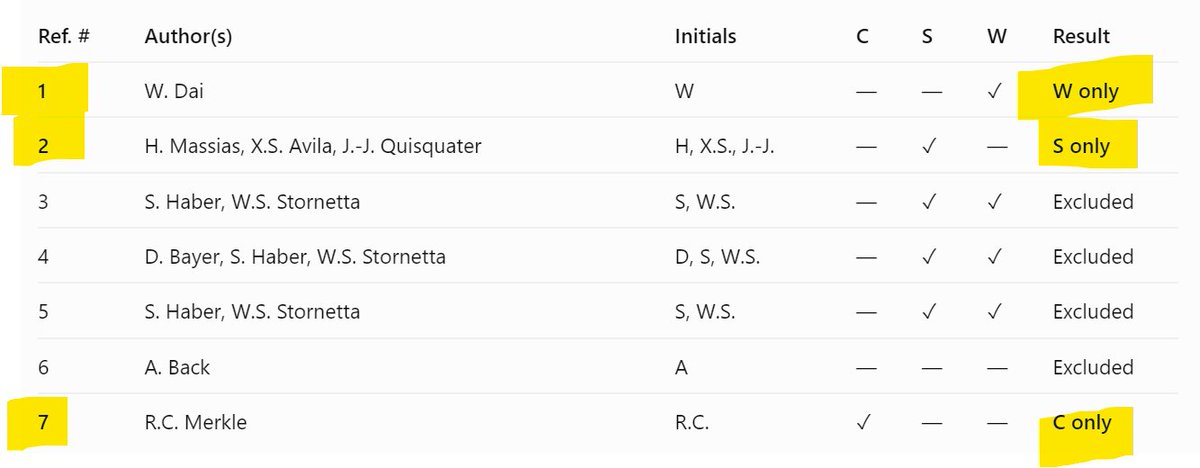
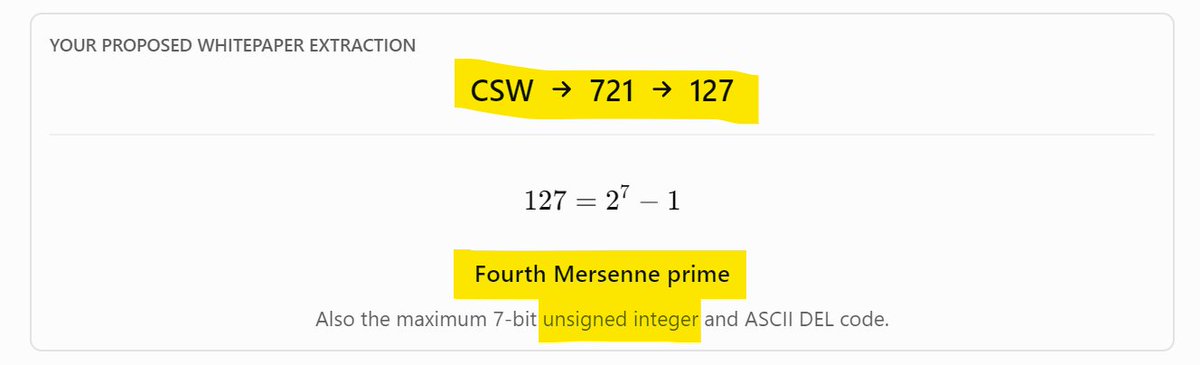
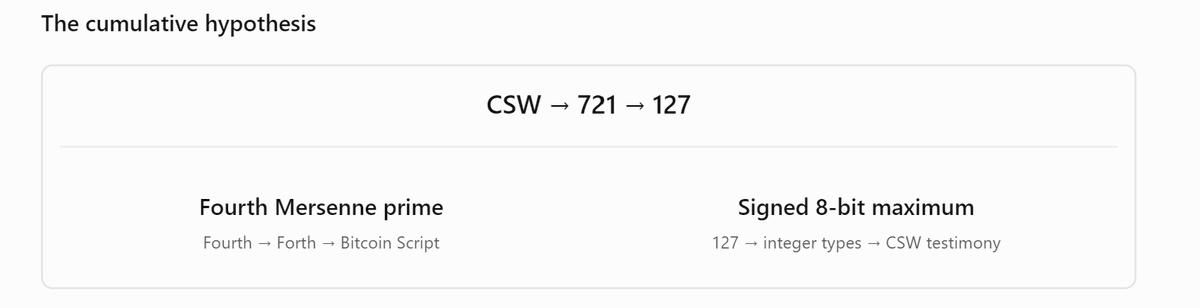
[7] [2] [1] = CSW Bitcoin Whitepaper steganography proof If we examine the first name initials of the References in Satoshi's Whitepaper, there is only one referenced name for each of the CSW's initials (only Reference #1 has EXCLUSIVELY the letter W in it, #2 with S, #7 with C) giving you 721. But, why did Satoshi place the C at the end instead of the beginning, giving WSC, when he had full control. He was pointing to intentionally INVERSE the numbers to [1][2][7]. But why? To remove any doubt, and dismissing the letters CSW appearing, as being mere "coincidence", Satoshi adds another layer (the need to inverse the order) making the possibility of being coincidental very small. Then, 127 happens to be the 4th (fourth) Mersenne Prime number; infinitely small chance of still being "coincidental". Why "fourth" or "Forth"? The programming language. We now have three independently established facts: 1. 127 is the fourth Mersenne prime. 2. Satoshi explicitly described Bitcoin Script as Forth-like in source code. 3. Craig Wright independently discussed Forth in connection with Bitcoin Script. Remember when CSW "fumbled" regarding the definition of an UNSIGNED INTEGER? Well, the number 127 is also the MAXIMUM positive value of a conventional signed 8-bit integer. A signed 8-bit integer typically represents: -128 to +127 The chances, of all these things (see final pic) occurring randomly, is astronomically small, if not, impossible. *credit to @roman_de_fauvel where he deciphered it all leading to his conclusion of being 725 where, I believe, he made some incorrect assumptions. @bsvdrip
Verify it yourself: the manifest is the exact JSON whose
SHA-256 is ce564c9f0d028fc631e507d6ecdafeeede67c14383044ee6ffc435c3ddf76582; it binds the tweet id, author, post time, and the SHA-256 of the text above. Re-hash the text to match 183691506aa6d0b1809be84d2632e4719eb20a23e6e19b189c94cb5cd9e4c655, and read the anchor transaction's OP_RETURN
bsv.cx / x1 / ce564c9f0d028fc631e507d6ecdafeeede67c14383044ee6ffc435c3ddf76582 — the block's timestamp proves the post said this at or before that time,
with no trust in bsv.cx. Content archived via the X API.